




Making innovative health technologies work: lessons from HLTH Europe 2026
Across HLTH Europe 2026, the message was clear: the barrier is no longer innovation itself, but whether health systems are ready to use it.
My first visit to HLTH Europe meant navigating a packed agenda, with more sessions than possible to attend. In the end, I found myself drawn to three themes that kept resurfacing in different ways: artificial intelligence (AI) technologies in health system transformation, place-based innovation, and women’s health.
What linked them all was a single, stubborn issue. The challenge is no longer invention,it is adoption and implementation. Perhaps, most importantly, it is also a matter of public and workforce trust.
Across the conference, there was a noticeable shift in tone. Less focus on what technologies can do, more on whether health systems can make use of them. The real question now is not capability, but whether innovation can land in live pathways, for real patients, at scale.

Radiology AI: beyond the demo
One of the most thought-provoking sessions for me took place on the radiology-focussed HLTH.rad stage, where the conversation moved well beyond the usual focus on performance metrics.
The core message was deceptively simple, and technical success is no longer the bottleneck. AI in radiology has already shown it can improve detection and support decision-making. The sticking point now lies elsewhere, in how these tools are embedded into workflows, governed safely, monitored over time, and made to work alongside clinicians. In the evolution of radiology AI, performance creates possibility,integration enables adoption, governance builds trust and monitoring sustains it. It is a hierarchy, but also a warning, since many AI tools never climb beyond the first step.
The discussion also turned to what comes next, with lessons from radiology also applicable across broader healthcare provision. As AI moves into an era of reasoning and, increasingly, action, the risks change. More capable systems bring harder governance questions. Fluent output is not the same as reliable output and if anything, the challenge deepens.
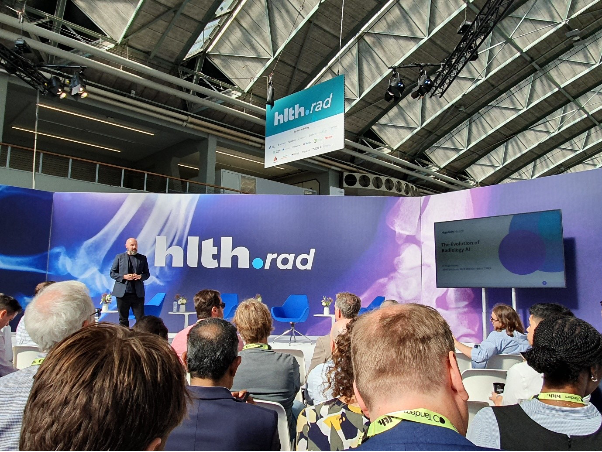
Perhaps the most audience-pleasing moment was a reframing of the workforce debate. Instead of asking whether AI will replace radiologists, the more relevant question was who will design, build, and manage the systems that radiologists will ultimately lead. That feels far closer to the reality facing the NHS and other health systems, where AIbrings opportunities to redesign, rather than replace the workforce.
Where does value actually sit?
If the radiology discussion focused on how AI works in practice, the main stage conversations asked a more fundamental question – where does its value sit, and how do healthcare systems capture it? There was a strong sense of realism here. Workforce pressures, financial constraints and rising demand are not background context, they are the drivers. What stood out was the way return on investment was described. Not as a financial calculation in isolation, but as something anchored in patient outcomes. Better care, fewer errors, earlier diagnoses. Efficiency and productivity gains followed on from those success metrics, rather than leading the value proposition for AI.
At the same time, there was little patience for endless pilot programmes. This is familiar territory across the North and beyond. AI does not scale as an add-on. It starts to spread only when it becomes part of how an organisation operates. The implementation of AI must be embedded in an organisation’s data, workflows, leadership priorities, and its culture. Several speakers returned to the same point in different ways. This is as much about people and behaviours as it is about technology.
Another important thread ran through this discussion – the idea that value in healthcare is rarely contained within a single organisation. Benefits spill across boundaries into prevention, earlier intervention and avoided harm. That makes regional and system-level thinking essential, rather than optional. Indeed, this principle is at the core of our work in the Northern Health Science Alliance.
Interoperability: the quiet constraint
A more grounded session on interoperability brought the conversation back to basics. AI depends on data. That sounds obvious, but the implications are not always taken seriously enough. If systems cannot exchange information cleanly, if data lack consistency or meaning, then even the most advanced models will struggle to deliver anything useful. What was particularly helpful here was the emphasis on meaning, not just movement. It is one thing to transfer data between systems. It is another to ensure that what is received is understood in the same way.
There was also a stark reminder of how easily bias can be embedded and reproduced. If historical data reflect unequal access to care, then models trained on those data will reinforce systematic health inequalities. That is not just a technical flaw, it directly affects patient safety and needs attention.
Alongside this sat a more fundamental point about trust. Data were consistently framed as belonging to patients, with organisations acting as custodians. Safe use, transparency and legitimacy are not peripheral concerns. They are central to whether AI adoption happens at all.
Place matters: a North versus South model of innovation
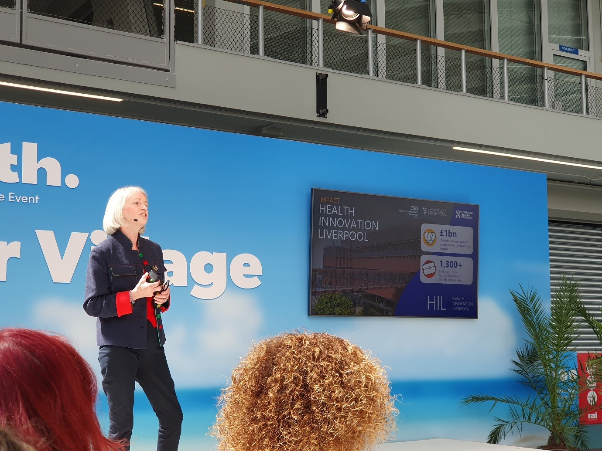
Moving away from AI, the many ‘Provider spotlight’ sessions on agenda offered a different but equally important perspective. Selecting two for these reflections – the first by our NHSA Board Chair, Professor Louise Kenny, showcasing Liverpool Health Partners, and the second, by Professor Jenny Shand, Strategic Advisor to Harley Street Health District.
The Liverpool story stood out as a strong example of northern place-based innovation. What came through clearly was that this is not just about infrastructure or institutional strength. It is about a system that has learned how to work together over time, with a level of trust that enables large-scale action. The experience of COVID mass testing was a powerful reflection of that. What follows from this is a more grounded approach to innovation, and one rooted in real communities, real pathways, and real needs. Louise’s focus on inequalities, particularly in women’s health, gave that narrative additionalweight. Innovation here is not abstract. For our northern populations, who face the greatest burden of health inequalities, as highlighted in our Health Equity North series of reports, it is immediate and necessary.
In contrast, the Harley Street Health District model offered a different kind of innovation ecosystem in London, one that is dense, highly specialised, closely tied to private investment, and built around proximity between providers, innovators and capital. Its strength lies in speed, concentration and access to expertise.
Set side by side, these approaches highlight something important. There is no single route to adoption. The North of England and London offer distinct but complementary ways of testing, validating and spreading innovation. Both are trying to solve the same core problem, how to move from idea to impact. However, the greater gains are likely to be made when research and innovation studies are placed where more patients and participants represent the intended clinical use cases of novel technologies. Chronic and co-morbid conditions prevail in the North of England, and recruitment to target data consistently show that our citizens want to contribute to clinical research and evidence generation for innovation.
Women’s health as a test case
As my first visit to HLTH drew to a close, I joined an inspiring roundtable session on adoption of technologies in women’s health. This brought the conversation back to where it had started. The issue is not a shortage of ideas, if anything, the opposite is true. The difficulty lies in getting those ideas into use, particularly within pathways that have not historically been designed around women’s needs.
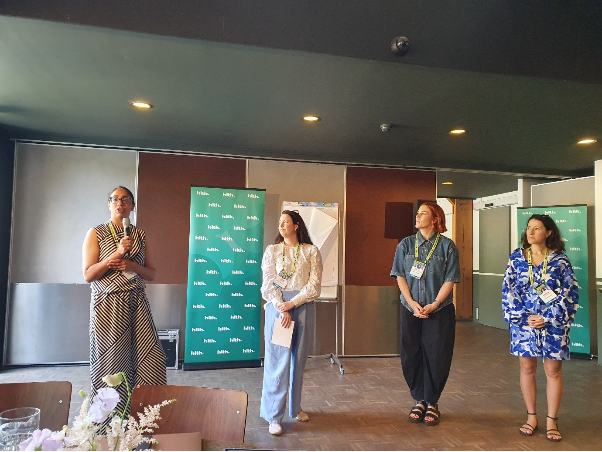
What emerged in discussion felt more immediate and practical than some of the earlier sessions. Fragmented routes into care. Uneven implementation. A persistent gap between evidence and uptake. These are familiar themes by now, but they land differently in this context. Women’s health acts as a test case for the system. If innovation cannot translate into meaningful improvements here, it raises questions about whether it can do so elsewhere.
The conversation also reinforced a broader point. Innovation is rarely blocked by technology alone. It is shaped by priorities, incentives, access to investment, lived experience and coordination across the system.
Final reflections
Looking back, the most striking thing about the HLTH Europe 2026 conference agenda is how little of the conversation centred on health technology itself. The real focus has shifted to the conditions that allow innovation to take hold. Integration, governance, trust, workforce readiness, system design.
For the North of England, that should feel like an opportunity. Amongst our NHSA member institutions, collaboration, strong regional partnerships and access to real-world populations are already in place. The challenge now is act deliberately, and to move beyond talking about innovation, towards making it routine at scale and delivering impact.