



When the Prime Minister met the Northern Health Science Alliance: Our time at Labour Party Conference
Our time at Labour Party Conference - by Hannah Davies, Chief Executive of the Northern Health Science Alliance and Executive Director of Health Equity North
When the Northern Health Science Alliance goes to conference we have a clear purpose: to speak for and put the evidence from our member universities, NHS organisations and health innovation networks directly in front of the people with the power to act. Our message was consistent. If we want a healthier, fairer country, we must unleash the North’s potential through building on its health and research assets and, addressing the inequalities, from funding to health, that shape lives across the North.
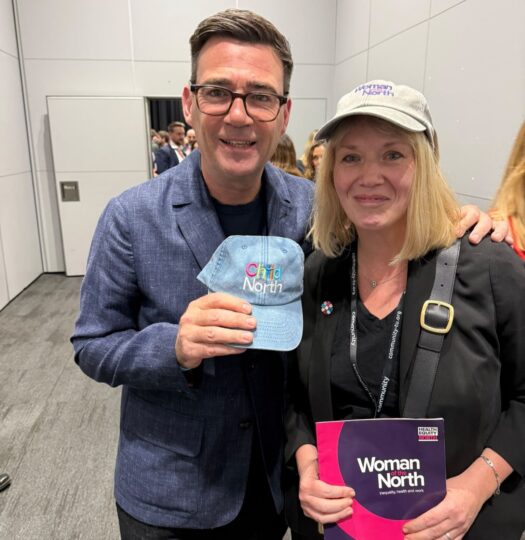
The highlight of Labour Party Conference was meeting Prime Minister Andy Burnham on the Sunday night, grabbing the opportunity to speak to him on our ambitions for a Northern Life Sciences Supercluster and our Woman of the North and Child of the North work.
The PM has long supported our work in his capacity as Greater Manchester Mayor, through letters to ministers, through attending our events and through sharing our research – notably at his Covid19 press briefings – so to have his continued support in his new role was wonderful.
A promise to unlock the North’s innovation potential
Had I spoken to the Prime Minister after his conference speech I would have also personally thanked him for his announcements on social care, NHS, child mental health, and universities.
As a family unpaid carer myself for the past decade I know all too well the complexities and frustrations of the current system and what an amazing job social care staff do.
A new social care system will be transformative and, as our Woman of the North report – endorsed by northern mayors Kim McGuinness and Tracy Brabin – shows women in the North do £10 billion a year worth of unpaid care (£2bn more than if they gave the same level of care as the rest of England). This service announced by Andy Burnham offers the potential to support families and drive productivity across the country and very significantly in our region.
Professionally and personally, NHS workforce is a key issue that we work with our members on across our networks, so to hear recognition of the job they do in often very challenging circumstances, was also welcome.
Children’s mental health is also an ongoing programme of work, the subject of our most recent Child of the North All Party Parliamentary group report in addition to our Child Health and Mental Health networks so to hear the PM support that was fantastic.
Supporting our drive for a Northern Supercluster in Life Sciences, the PM’s recognition of the vital role of universities in driving growth, and the need to support promising spinouts to scale and retain their jobs, investment and intellectual property in the UK was warmly welcomed. For the North, that means backing the world-class research emerging from our universities and NHS organisations with the investment and infrastructure needed to turn innovation into better health and shared prosperity.
Turning northern evidence into action
Our Health Equity North work repeatedly shows how poverty, poor health and unequal opportunities can accumulate across the life course – whilst the North is left behind in research funding, creating a double barrier to being able to meaningfully address inequalities.
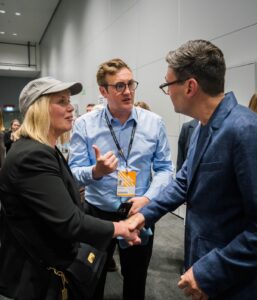
Children’s health and wellbeing, the number of young people not in education, employment or training, and the experiences of women are not separate policy challenges. They are connected – and they are shaped by where people live, the investment their communities receive and whether public services recognise their needs. This is why it was encouraging to speak with a Prime Minister who understands the challenges facing women and children across our northern communities. His support and his pledge to do what he can for people across the North reflected a wider sense of optimism at conference about what could come next for our regions.
Our supporters at Labour Party Conference
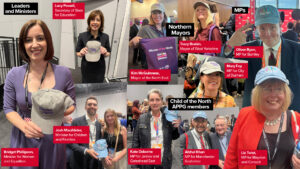
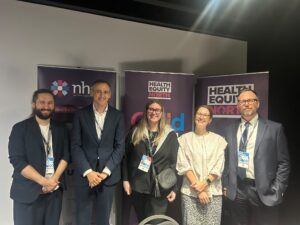
We were delighted to have Mayors, Ministers and MPs show support for our Woman of the North and Health Equity North work at party conference – as you can see, we spoke to many who happily posed with our much-sought after hats.
Bringing our research to Labour Party Conference
We held four impactful events at the party conference, each focussing on a pressing need in the North:
Northern Prosperity: Growth through Health Research and Innovation: Our private roundtable, held in partnership with Liverpool Health Partners and The Great North, brought together policymakers, industry leaders and experts from across our member organisations to explore how the North can build a more connected, scalable and impactful research and innovation ecosystem.
The discussion focused on how the region’s existing strengths in health and life sciences can drive innovation-led growth, improve health and ensure the benefits reach communities across the North. Josh Fenton-Glynn, MP for Calder Valley and a member of the Health and Social Care Committee, brought a valuable government perspective to the discussion and heard directly from sector leaders about the barriers that must be addressed to unlock the North’s full potential.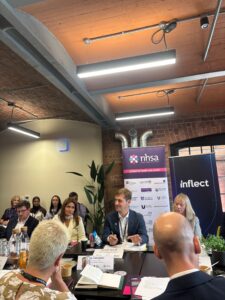
What next for children’s mental health in the North of England? The Child of the North panel brought together policymakers, academics, charity-sector experts and young people to examine the growing mental health challenges facing children across the North. The discussion highlighted the value of listening directly to lived experience and putting prevention at the heart of a system that helps every child to thrive.
Lewis Atkinson, MP for Sunderland Central, joined Health Equity North Academic Director Professor David Taylor-Robinson of the University of Liverpool and Alder Hey Children’s Hospital, Greg Kay of the Children and Young People’s Mental Health Coalition (CYPMHC) and Hope from the Liverpool University Young Person’s Advisory Group to consider how government can move towards a preventative approach that intervenes earlier and gives every child the opportunity to thrive.
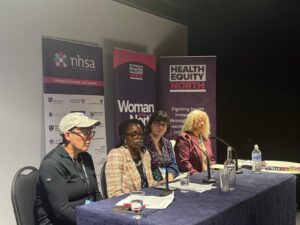
Addressing inequalities in health: from minority ethnic women’s perspective. Our Woman of the North panel, chaired by HEN Director Professor Clare Bambra of Newcastle University explored the barriers affecting minority ethnic women across health and wider society.
Speakers considered how government, services and communities can work together to improve culturally responsive support, strengthen women’s voices in decision-making and turn the evidence in our forthcoming report into action. Yet policymakers are still too often working without the detailed, joined-up data needed to see who is being left behind. Gaps in evidence can hide inequalities, weaken accountability and make it harder to design services around the people who need them most. Better data is not an academic nice-to-have; it is fundamental to better decisions. Kim Johnson, MP for Liverpool Riverside, spoke powerfully about her experience as a Black woman born and raised in the city, and stressed that minority ethnic women’s lived experience, leadership and expertise must be central to the policies and services that affect their lives.
Poverty in Place: how local and regional government can tackle poverty. Delivered in partnership with the York Policy Engine, our final session brought together voices from Trussel Trust, Resolve Poverty and the University of York.
The panel, including myself speaking as a HEN director examined how poverty differs between places, the challenges of coordinating action across policy portfolios, and how national, regional and local government can work together to deliver lasting change. Rachael Maskell, MP for York Central and Co-Chair of our Child of the North APPG, brought a policymaker’s perspective to the discussion, reinforcing the need for national and local government to work in partnership and use evidence to deliver solutions shaped around the needs of different places.
Harnessing data and AI for healthier, more inclusive growth
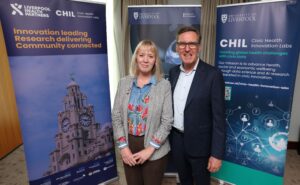
I also joined an important University of Liverpool’s Civic Health Innovation Labs (CHIL) roundtable in Liverpool.
The roundtable examined how trusted data, responsible AI and civic partnerships can improve health, work and opportunity, alongside industry colleagues and former Health Secretary Alan Milburn. It was particularly valuable to contribute alongside Professor Iain Buchan, Director of CHIL and a highly valued alliance colleague of the NHSA, whose leadership is helping to demonstrate how Liverpool’s strengths in data and AI can support prevention, tackle health-related economic inactivity and deliver more inclusive growth.
By continuing to work together across the North and beyond, our alliance can turn these innovations into practical solutions that improve lives and strengthen northern economies.
Next week: new evidence on minority ethnic women
Next week, Health Equity North will publish Woman of the North: Closing the health gap for minority ethnic women. Co-led by Dr Nasima Akhter of Teesside University and Dr Oluwaseun Esan of the University of Liverpool, and developed with more than 50 researchers – most of whom are minority ethnic women – it brings together evidence on how ethnicity, gender and place shape women’s lives.
The report exposes inequalities from childhood and maternity care through to employment, mental health and later life. It finds that racial discrimination, poverty and regional underinvestment combine to produce worse outcomes, while major gaps in data continue to obscure the true scale of the problem. It also highlights the vital work of voluntary, community, faith and social enterprise organisations — and why they need sustained investment and stronger system-wide support.
The evidence is clear: these inequalities are not inevitable. Government, regional leaders, the NHS, researchers and communities can change outcomes when they work together, invest for the long term and ensure the women affected have a meaningful voice in the policies and services that shape their lives.
Look out for the full Woman of the North report next Wednesday, 7 October. We will be sharing its findings and recommendations, and continuing to take this evidence to decision-makers so it drives measurable change for women, children and communities across the North.
A healthier start for babies could help build a healthier North
At Labour Party Conference, Secretary of State for Health and Social Care Yvette Cooper MP announced that the Healthy Babies programme will be expanded to every local authority in England, bringing Sure Start-style health services into family hubs across the country. The programme will provide support with infant feeding, parental mental health and bonding, alongside health visiting and midwifery care, with the ambition of reaching up to 1,000 hubs over the next two years.
Health Equity North Academic Directors Professor David Taylor-Robinson, Professor of Public Health and Policy at the University of Liverpool and Professor Kate Pickett, Professor of Epidemiology at the University of York, have issued a statement following this announcement:
“This is a welcome step towards giving every baby the best possible start in life. For the North of England, this is a particularly important opportunity. We know through our Child of the North APPG research that inequalities in health and life chances begin early, and that the conditions in which children grow up can have consequences throughout their lives.
“The need for action is increasingly clear. Early-years outcomes have stagnated in a number of areas, while inequalities are widening across many aspects of children’s health and development. We are also seeing concerning gaps in areas such as childhood vaccination, meaning that some babies and children are missing out on important protection from preventable illness. These inequalities do not emerge in isolation – they reflect the wider social, economic and environmental circumstances in which families are raising their children.
“Bringing health, family and early-years support together in communities could help reach families earlier, build trusted relationships and provide support before challenges become more entrenched.
“The key now will be making sure the expansion reaches the families who need it most, with services that are accessible, trusted and responsive to the needs of different communities. Investing in babies and families is an investment in the North’s future – and this expansion provides an important opportunity to put prevention and tackling inequalities at the heart of that investment.”