



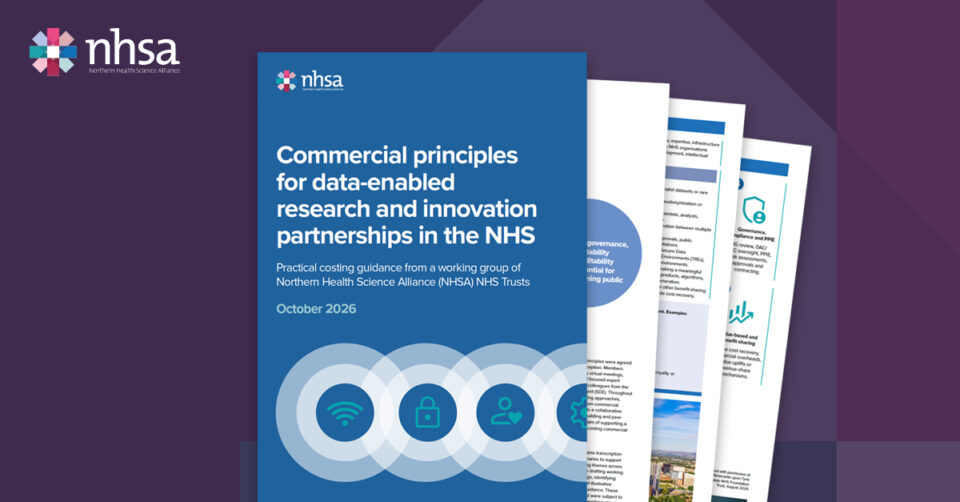
Northern Health Science Alliance publish new guidance on commercial principles for data-enabled research and innovation partnerships
The Northern Health Science Alliance (NHSA) has published new practical guidance to support NHS organisations in costing data-enabled research and innovation partnerships more consistently, transparently and sustainably.
15th October 2026
Developed by a working group of NHS Trusts from across the North of England, ‘Commercial principles for data-enabled research and innovation partnerships in the NHS’ responds to growing demand from industry partners seeking access to NHS data, expertise, infrastructure and analytical services to support research, innovation and product development.
The report provides a practical framework to help organisations identify the full scope of activity involved in data-enabled projects and recover the costs associated with delivering them safely, legally and effectively.
Rather than prescribing prices or tariffs, the guidance sets out a common set of principles and recommended approaches covering:
- Full cost recovery
- Feasibility assessments
- Governance and compliance activities
- Data preparation and delivery
- Infrastructure and technical costs
- Value-based and benefit-sharing approaches
- Delivery of multi-organisation projects
A key message of the report is that data-enabled projects involve much more than data extraction alone. Activities such as governance review, patient and public involvement, technical setup, specialist expertise and infrastructure support represent significant costs that should be recognised and recovered.
Developed in the spirit of “One NHS”, the report is intended to support a more coordinated national conversation about how NHS organisations can maximise public benefit from data-enabled innovation while maintaining public trust and ensuring sustainability. Although NHS England’s 2023 Value Sharing Framework is now considered historical guidance, the NHSA working group continues to endorse its key principle that NHS organisations should recover the costs of providing access to health data, including appropriate overheads.
Helen Cole, Executive Lead for Health Technologies and Evaluation, said: “The guidance highlights opportunities for NHS organisations to consider value-sharing and longer-term benefit arrangements where NHS data, expertise and infrastructure contribute to commercial innovation and future value creation.
“Our working group recognised that unwarranted variation in costing approaches can weaken the NHS’s negotiating position, lead to inconsistent value recovery and create challenges for organisations seeking to work together on commercial projects. The guidance aims to support greater consistency while respecting local decision-making and organisational flexibility.
“Working group members highlighted substantial variation in current practice, citing an example where a commercial project specification attracted quotes of £500 and £55,000 from different NHS Trusts. This hundred-fold disparity illustrates the potential scale of missed income generation opportunities that could otherwise support frontline services, research, and innovation within the NHS.”
Download the guidance and supplementary resources.
Related News Articles
Women's Health in the North of England - gallery
View photos from our event with the Academy of Medical Sciences on October 7: Women's Health in the North of England - Turning Evidence into Action.
Read the articleMRC North RACR BEACON Award applications open
Find out more about the MRC North RACR BEACON Award.
Read the articleNorthern bioscience and health technology sector bucks national trends with continued growth
Northern bioscience and health technology sector showing resilience and growth
Read the article