



Northern bioscience and health technology sector bucks national trends with continued growth
Northern bioscience and health technology sector showing resilience and growth
24th September 2026
The North of England is the fastest growing region for biopharmaceuticals in the country, new data reveals.
The medtech sector in northern regions is showing resilience while biopharmaceuticals is growing rapidly according to figures published by the Office for Life Sciences.
This contrasts the national picture where the bioscience and medtech sectors have stalled and declined in some areas.
The data provides a snapshot of the life sciences industry in the UK between 2024 and 2025. The figures are split into two main subsectors, biopharmaceuticals and medical technology, and they report on three measures: the number of companies, employment, and turnover.
Nationally, the number of life sciences companies overall down is by 3.4%, employment has also seen a drop of 2.1%, and turnover has decreased by 1.2%.
While overall in the North the number of companies has decreased, both employment and turnover have increased. The figures show:
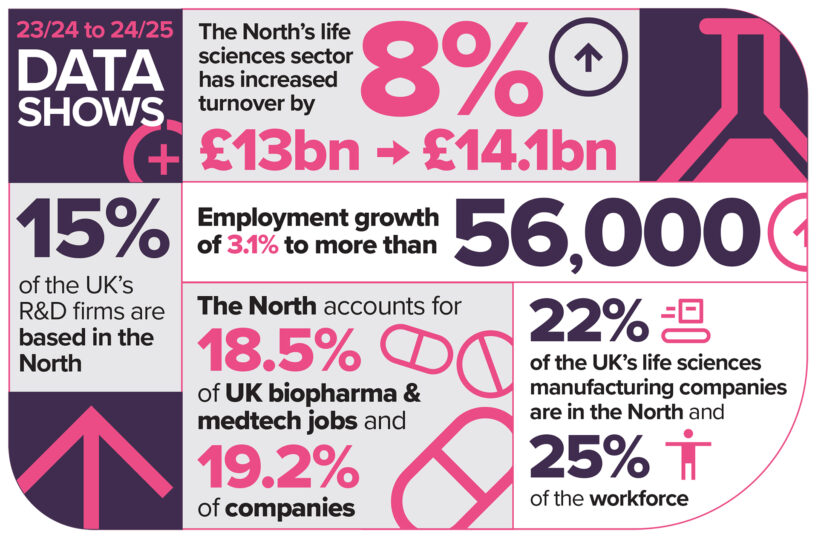
- Despite the number of northern companies shrinking by 4.3%, the North has grown turnover by 8% – from £13bn to £14.1bn.
- The North has seen employment growth of 3.1% to more than 56,000 people.
- Overall, the North has 18.5% of all biopharmaceutical and medtech employment and 19.2% of companies.
- 22% of the country’s life sciences manufacturing companies are in the North and 25% of the workforce.
- The North maintains a healthy research and development (R&D) base with 15% of the country’s R&D firms based in the region.
- The North West is the largest life sciences region in the North, turning over £7.7bn. Employment went up 7.9%, driven by a 25% increase in biopharmaceutical employment, the fastest growing biopharmaceutical region in the country by some margin (+2,660 jobs vs +775 jobs in London in second place).
- In the North East, overall employment remained static thanks to a small increase in biopharmaceutical employment matching a contraction in medtech. During the period, the biopharmaceuticals sector turnover increased by 22% from £0.8bn to £1bn.
- Yorkshire and Humber accounts for 40% of the North’s life sciences sector in terms of employment, generating £5bn in turnover, and employing 22,000 people across more than 500 companies. Two thirds of these are made up by medtech companies.
- The Yorkshire and Humber region saw a 3.6% reduction in number of companies, and a -1.2% workforce shrinkage, but turnover has increased by 4.2%. This has been driven by 12% growth in the biopharmaceutical subsector, which also saw 105 new jobs created.
- In addition, Yorkshire and Humber saw a 20% increase in non-SME companies, pointing to a combination of SMEs successfully scaling up and attraction of larger firms into the region.
Conversely, other regions are seeing different trends. There was a 20% reduction in medtech workforce in London, and turnover reduced by £64m (a 1.2% decrease). While the West Midlands saw a 24% reduction in biopharmaceutical employment and a 30% reduction in biopharmaceutical turnover, equivalent to £570m revenue.
Northern Ireland was the only region in the UK to see a growth in employment in the medtech sector, increasing by 6%.
Hannah Davies, Chief Executive Officer at the Northern Health Science Alliance (NHSA), said: “While the latest national data shows the bioscience and health tech sector navigating headwinds and consolidation, the picture in the North of England tells a different story. Our region continues to demonstrate remarkable resilience, with companies creating jobs, driving productivity and contributing positively to local economies.
“Growth in biopharmaceuticals, alongside the continued stability of our traditionally strong medtech base, highlights the depth of excellence across the North’s innovation ecosystem. We may be smaller in scale compared to some other regions, but the evidence is clear: the North’s bioscience and health tech sector is robust, competitive and delivering real economic value.
“The North’s success is an example of what can happen when the triple helix of academia, industry and government work together. It is growth we want to see across the entire UK life sciences ecosystem with continued investment in and support of the sector nationwide.”
Dr Ben Martyn, Executive Lead for Investment and International Partnerships at the NHSA, said: “These figures reinforce that the North is a powerful place to do business in bioscience and health technology. Our companies are proving their strength in challenging conditions, achieving high productivity gains, and continuing to invest in people and communities. This is a positive story for the North’s economy and a testament to the world‑class capability that exists here.”
The ‘Bioscience and health technology sector statistics 2024 to 2025’ can be accessed here.
Related News Articles
Northern Health Science Alliance publish new guidance on commercial principles for data-enabled research and innovation partnerships
The Northern Health Science Alliance (NHSA) has published new practical guidance to support NHS organisations in costing data-enabled research and innovation partnerships more consistently, transparently and sustainably.
Read the articleWomen's Health in the North of England - gallery
View photos from our event with the Academy of Medical Sciences on October 7: Women's Health in the North of England - Turning Evidence into Action.
Read the articleMRC North RACR BEACON Award applications open
Find out more about the MRC North RACR BEACON Award.
Read the article